
In-Home Pet Euthanasia: What Happens from Start to Finish
Most families who choose in-home euthanasia say the same thing afterward: knowing what to expect made it more bearable. This guide walks through the appointment step by step, from the vet's arrival to what happens after, so nothing catches you off guard. It also covers what to prepare, who can be present, and how to find a provider.
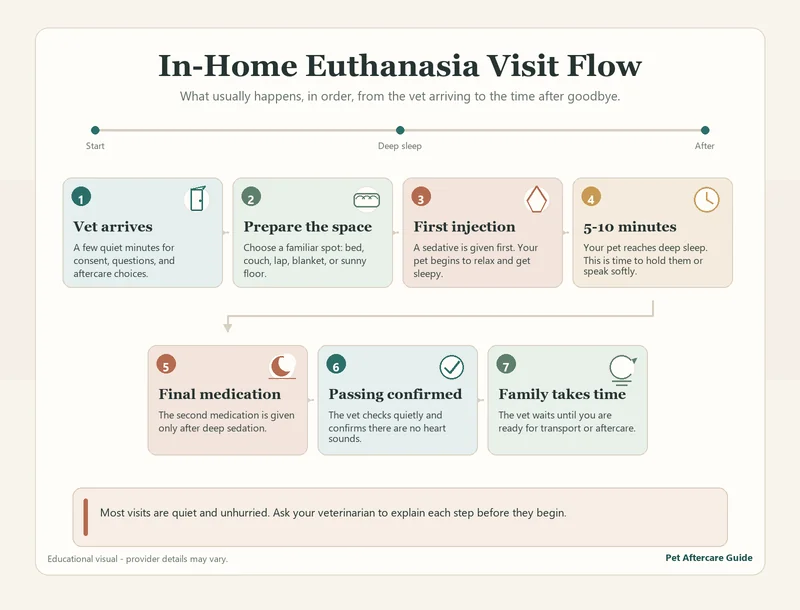
An in-home pet euthanasia appointment takes 30 to 60 minutes. A sedative is given first, which puts your pet into a deep sleep within 5 to 15 minutes. The final injection is then given intravenously. Your pet will not feel pain. The vet confirms passing with a stethoscope and stays until you are ready.
Quick answer: An in-home pet euthanasia appointment typically takes 30 to 60 minutes from the vet's arrival to departure. There are two injections: a sedative first, which puts your pet into a deep sleep over 5 to 10 minutes, and then the final medication. Your pet will not feel pain during the second injection.
If you have scheduled an in-home appointment or are considering one, this guide walks through exactly what happens, in order, so you know what to expect at each step. There are no surprises here.
How is an in-home appointment different from euthanasia at a clinic?
The medical procedure is identical. The same two medications are used, in the same sequence. The difference is environment, pacing, and who is in control of the space.
At a clinic, your pet is in an unfamiliar place with unfamiliar smells, often anxious from the car ride. The appointment may feel rushed. You may be in a small exam room.
At home, your pet is on their own bed or in your lap. There is no waiting room, no other animals, no fluorescent lights. The vet comes to you. Most families who have experienced both describe the in-home appointment as significantly calmer, for the pet and for themselves.
The cost difference is real: in-home euthanasia typically runs $300 to $600, compared to $100 to $250 at a clinic. The price reflects the vet's travel time and the extended appointment window allocated to each visit.
What happens when the vet arrives?
The vet will introduce themselves and spend a few minutes talking with you before anything else happens. This is not filler. Most in-home euthanasia vets are specifically trained in end-of-life care and will check in on how you are doing, confirm your pet's name and history, and walk through what is about to happen so there are no surprises.
You will be asked to sign a consent form. This documents that you have authorized the procedure and chosen your aftercare option (cremation, burial, or taking your pet home). If you have not yet decided on aftercare, this is the moment to ask.
The vet will ask where you would like the appointment to take place. Most families choose a favorite spot: a couch, a dog bed, a sunny patch of floor. Anywhere your pet is comfortable is the right answer.
What does the sedation injection do and what will I see?
The first injection is a sedative, typically given under the skin or in the muscle, often in the scruff of the neck or the hindquarters. Some pets flinch briefly at the injection, and a small number find the medication slightly uncomfortable going in. This passes within seconds.
Over the next 5 to 15 minutes, your pet will become visibly drowsy. They may take a few wobbly steps. Some pets give a long sigh. Most simply relax into wherever they are lying and fall into what looks like a deep, peaceful sleep.
According to Lap of Love's veterinary team, which has performed over 500,000 in-home euthanasia appointments across the US, pets are typically in a deep sedated sleep within 10 minutes of the first injection. The vet will gently check the depth of sedation, usually by pressing firmly on a toe. When your pet no longer responds to that, the sedation is deep enough to proceed.
This is a good time to say what you want to say. Hold your pet if you want. There is no rush.
What happens with the final injection?
The final medication is a concentrated solution that stops the heart. It is given intravenously, usually in a leg vein. Because your pet is already deeply sedated, they feel nothing.
Within 6 to 12 seconds of the injection, your pet will take a slightly deeper breath and then go still. The vet will confirm passing with a stethoscope, listening for heart sounds for 1 to 2 minutes.
Some things that are normal and may be unexpected:
- A final deep breath or sigh at the moment of passing
- A brief muscle twitch or full-body relaxation
- Eyes that remain partially open (this is common and does not indicate distress)
- Bladder release (the muscles relax completely)
None of these are signs of pain or distress. They are reflexes that occur as the nervous system finishes its work.
How long does the whole appointment take?
Most in-home euthanasia appointments last 30 to 60 minutes from the vet's arrival to departure. Providers typically allocate a 2-hour window, so there is no sense of being hurried.
The time breaks down roughly like this:
- Arrival, introductions, consent form: 5 to 15 minutes
- Sedation and waiting for deep sedation: 10 to 20 minutes
- Final procedure: 2 to 5 minutes
- Time with your pet after: as long as you need
The vet will not leave until you are ready. Most families want 10 to 30 minutes alone after the procedure before the vet handles transport. Some want longer. That is always accommodated.
What should I prepare before the vet arrives?
You do not need to do much. The vet brings everything required for the procedure. A few things that help:
Choose a location in advance. Pick your pet's favorite resting spot. Lay down their bed or a familiar blanket. Having this decided before the vet arrives removes one decision from a difficult moment.
Decide who will be present. Children can be present. Many families include them and find it a meaningful experience. There is no right number of people. If you want just yourself and your pet, that is completely fine.
Think about aftercare in advance. You will be asked whether you want communal cremation, private cremation, or to handle burial yourself. If you are not sure yet, our guide on cremation versus burial covers the differences in cost and what each involves.
Have water nearby. For you. The vet will not need anything, but you may want it.
Consider other pets. Some families keep other pets in the room; others prefer to keep them separated. Both are fine. There is no evidence that other pets need to be present, though some families feel it helps with the surviving pet's own grieving process.
What happens after my pet passes?
The vet will give you time alone with your pet before discussing transport. If you have chosen cremation, the vet or a transport team will take your pet with them. If you have chosen to handle burial yourself, you can ask the vet to leave your pet with you.
Most providers include a paw print impression and a small fur clipping as part of the service. If this matters to you, confirm it when you book.
If you chose private cremation, your pet's ashes will typically be returned to you within 5 to 10 days, depending on the provider and your location.
In the days after, you may feel a range of things: relief, grief, guilt, or all three at once. Our grief guide on grieving your pet covers what to expect and where to find support.
How do I find an in-home euthanasia provider?
Two national networks cover most major US cities: Lap of Love and CodaPet. Our full reviews cover coverage areas, pricing, how to book, and what families have said about their experience.
If you are still deciding whether in-home euthanasia is the right choice for your family, our guide on when it is time to euthanize your pet covers the quality-of-life assessment process and how to make that decision with your vet.
Ready to find a provider near you?
We've reviewed local providers in major cities with verified prices.
Find ProvidersWant to know what to expect to pay? See our in-home euthanasia cost guide.