How to Choose a Pet Urn: Size, Material, and What Actually Matters
Most people buy their first pet urn under time pressure and get the size wrong. This guide covers the one calculation that matters most, how to compare materials, what to look for in closure and construction, and what you should expect to pay.
Multiply your pet's body weight in pounds by 1.2 to get the minimum cubic inches your urn needs. A 50-lb dog needs at least 60 cubic inches. Most families buy too small. Material choice depends on whether you plan to keep, bury, or display the urn. Wood and ceramic are most common for home display; biodegradable materials are best for burial.
If you have never bought a pet urn before, the sizing math is the part most people get wrong. This guide covers size, material, and a few details most listings do not mention, including what actually holds up over time and what to watch out for in cheaper options.
How do you calculate the right urn size?
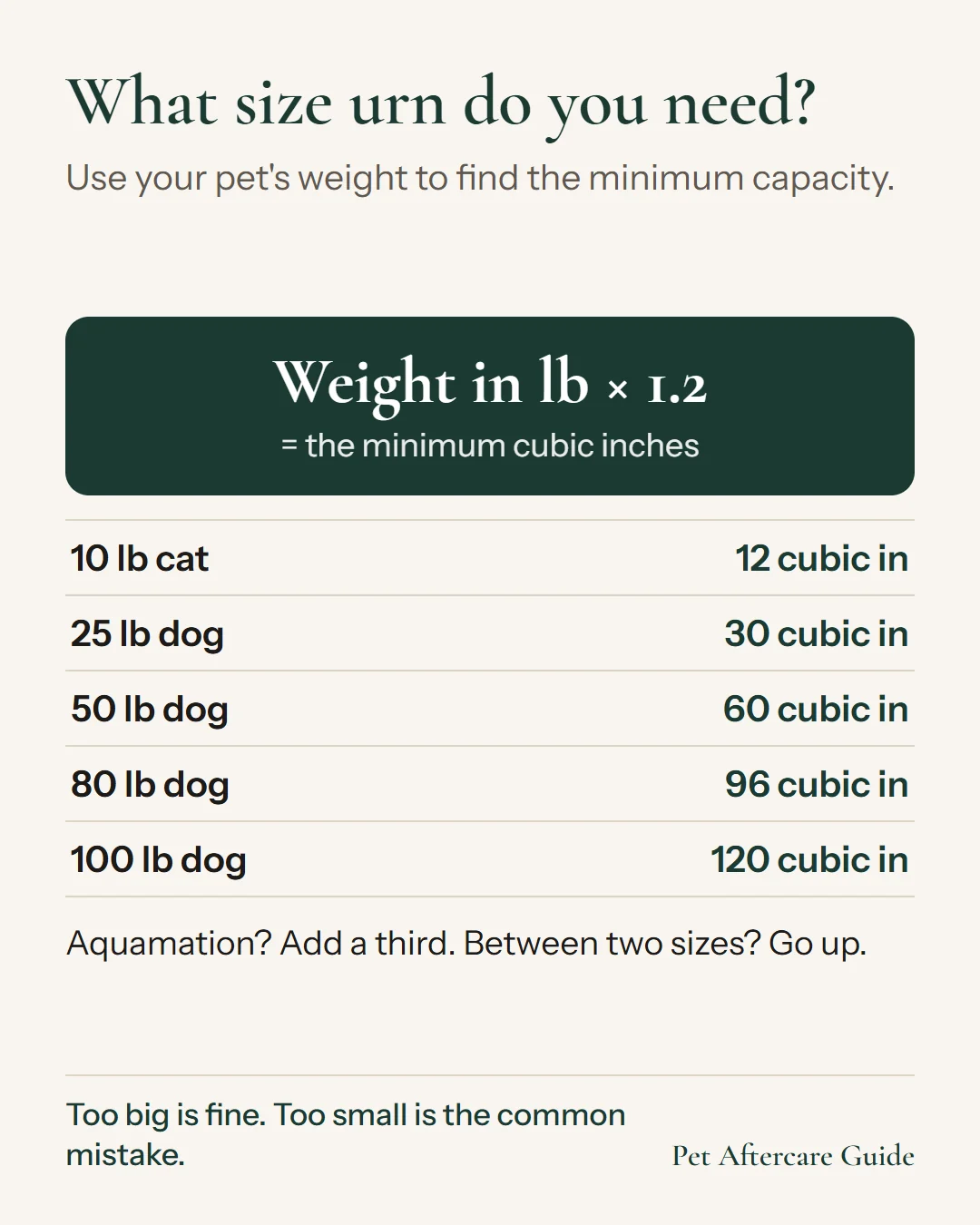
The standard formula: take your pet's body weight in pounds and multiply by 1.2. That gives you the minimum cubic inches your urn needs to hold.
Examples:
- 10-lb cat: needs at least 12 cubic inches
- 25-lb dog: needs at least 30 cubic inches
- 50-lb dog: needs at least 60 cubic inches
- 80-lb dog: needs at least 96 cubic inches
- 100-lb dog: needs at least 120 cubic inches
Most retailers list urn capacity in cubic inches. If a listing only shows dimensions (e.g., 6" x 4" x 3"), calculate the volume yourself: for a rectangular box, multiply length × width × height to get total volume. For cylindrical or rounded urns, the usable volume is closer to 50-55% of that number, so factor that in when comparing options.
Why most people buy too small: Cremation ashes are denser and more voluminous than most people expect. The cremation process reduces a pet to bone fragments that are then ground to a fine powder, and the resulting volume surprises families who picture something like fireplace ash.
If your pet was cremated via aquamation, add about a third to your calculation. Aquamation returns about 32% more ash volume than flame cremation because no material is burned off as carbon. Our article on what is pet aquamation explains the process in detail.
When in doubt, buy one size up. An urn that is slightly large is not a problem. An urn that does not hold all the ashes is.
What are the main urn materials?
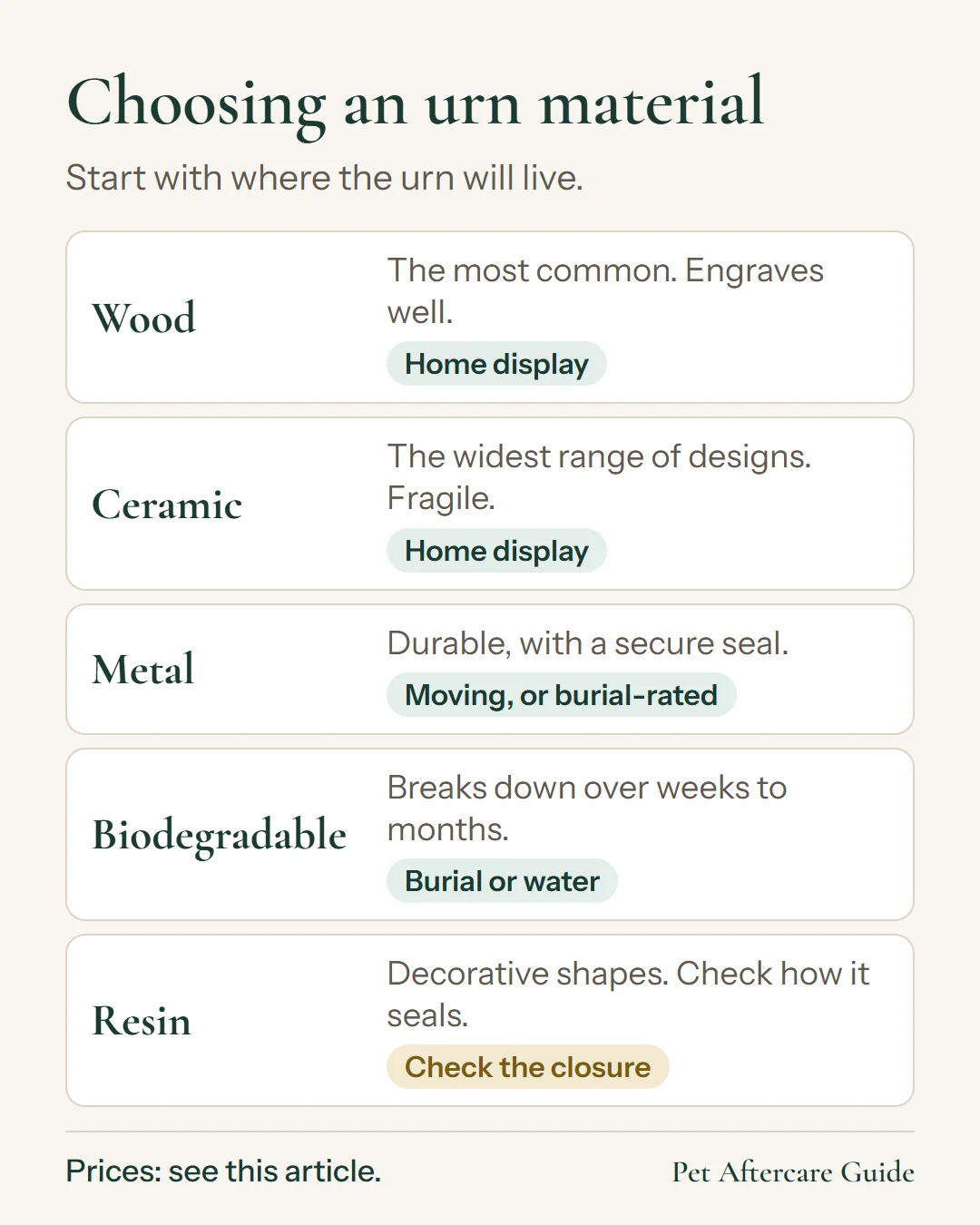
Wood. The most common material for pet urns. Holds up well, comes in every finish and price point ($40 to $400+), and can be laser-engraved easily. Suitable for keeping at home long-term. Most basic wooden urns have a bottom panel that unscrews or slides open. Do not leave a wood urn in direct sunlight or high humidity for extended periods, as both can warp the material or fade the finish.
Ceramic. More decorative range than wood. Can be shaped to look like animals, flowers, or abstract forms. Typically hand-sealed. More fragile than wood but visually distinctive. Price range $60 to $500+. Pulvis Art Urns specializes in handcrafted European ceramic urns with a reputation for quality and craftsmanship that holds up well over time.
Metal (brass, aluminum, stainless). Durable, secure seal, often used for outdoors or as a base for buried urns. Can feel cold to the touch. Typically less customizable in appearance than wood or ceramic. Good for families who want a permanent, secure container that does not require special care or protection from humidity.
Biodegradable. Made from paper pulp, bamboo, or salt. Intended for burial or ocean placement. They break down over weeks to months depending on material and environment. Not suitable for keeping at home long-term, as they are not designed to be handled repeatedly. The Living Urn is the best-known brand for tree-planting biodegradable urns.
Resin and composite. Often used for decorative or animal-shaped urns. Price and quality vary widely. Look for urns that specify how the ashes are loaded and sealed. Some decorative resin urns have no secure closure, which becomes a problem if you plan to move the urn.
What features actually matter?
Secure closure. The urn needs a closure mechanism that will not come open accidentally. Threaded closures (twist-to-open base or lid) are most reliable. Sliding panels and pressure-fit lids are less secure. For any urn you plan to move or travel with, confirm the closure type before buying.
Ashes loading method. Most urns load from the bottom (base panel screws off) or from the top (lid removes). Some decorative urns have a hidden closure behind the piece. Know how the ashes will be transferred in before you buy. If you have limited dexterity or expect to do this alone, a wide-opening base is easier to manage.
Engraving and personalization. Most wood and metal urns can be laser-engraved with a name, dates, and a short message. Some retailers include engraving in the price; others charge $25–$60 extra. Turn-around for engraving is typically 3-7 business days, so factor that in if you are under time pressure.
Interior lining. Higher-quality urns have a velvet or felt lining that cushions the sealed plastic bag of ashes. This is not essential but is a sign of quality construction in a mid-range or premium urn.
What about keepsake urns and divided ashes?
Keepsake urns are small urns (typically 3–15 cubic inches) intended to hold a small portion of ashes, not the full volume. They are used when a family wants to divide ashes: keeping most at home while giving siblings or children a small piece to keep separately.
If you are buying for multiple family members, purchase one full-size urn plus however many keepsake urns you need. A keepsake urn typically holds a tablespoon to a quarter cup of ashes.
OneWorld Memorials offers a wide selection of keepsake urns, including smaller versions that match many of their full-size urns, which is useful if you want a consistent set across multiple family members.
Choosing an urn if you plan to bury it
If you plan to bury the urn in a garden or pet cemetery, get a biodegradable option or a metal urn rated for burial. Wooden urns degrade over time in soil but not consistently, and they may leave fragments rather than breaking down cleanly. Ceramic urns will last underground but do not break down at all.
For burial in a pet cemetery with a niche or vault, confirm the maximum dimensions the niche accepts before purchasing. Niche openings vary significantly between facilities, and returning an urn that does not fit is an avoidable complication when you are already navigating a difficult time.
What should you expect to pay?
- Budget wood or resin urn: $30–$60
- Mid-range wood, ceramic, or metal: $80–$200
- Handcrafted or artist-made ceramic: $150–$500
- Custom or memorial art pieces: $300–$1,000+
- Keepsake urns (small): $20–$80
Shipping adds $10–$25 for most standard urns. Rush delivery is available from most major retailers for an additional fee. If you need the urn within 2-3 days, confirm shipping speed before ordering. Standard shipping from some retailers takes 5-7 business days.
For a broader overview of all your options for what to do with your pet's ashes beyond buying an urn, see our guide on what to do with pet ashes. If you are also considering cremation jewelry, our next article in this series covers pet cremation jewelry including pricing and how to order.
Looking for a way to remember your pet?
Compare urns, jewelry, portraits, garden stones and keepsakes, with real prices and the stores we recommend.
Browse Memorial Products