What to Do with Pet Ashes: Every Option Explained
If you have your pet's ashes and are not sure what to do with them, you are not behind. There is no timeline and no single right answer. This guide covers every option in practical detail, including what each costs, what the legal rules are, and how to decide.
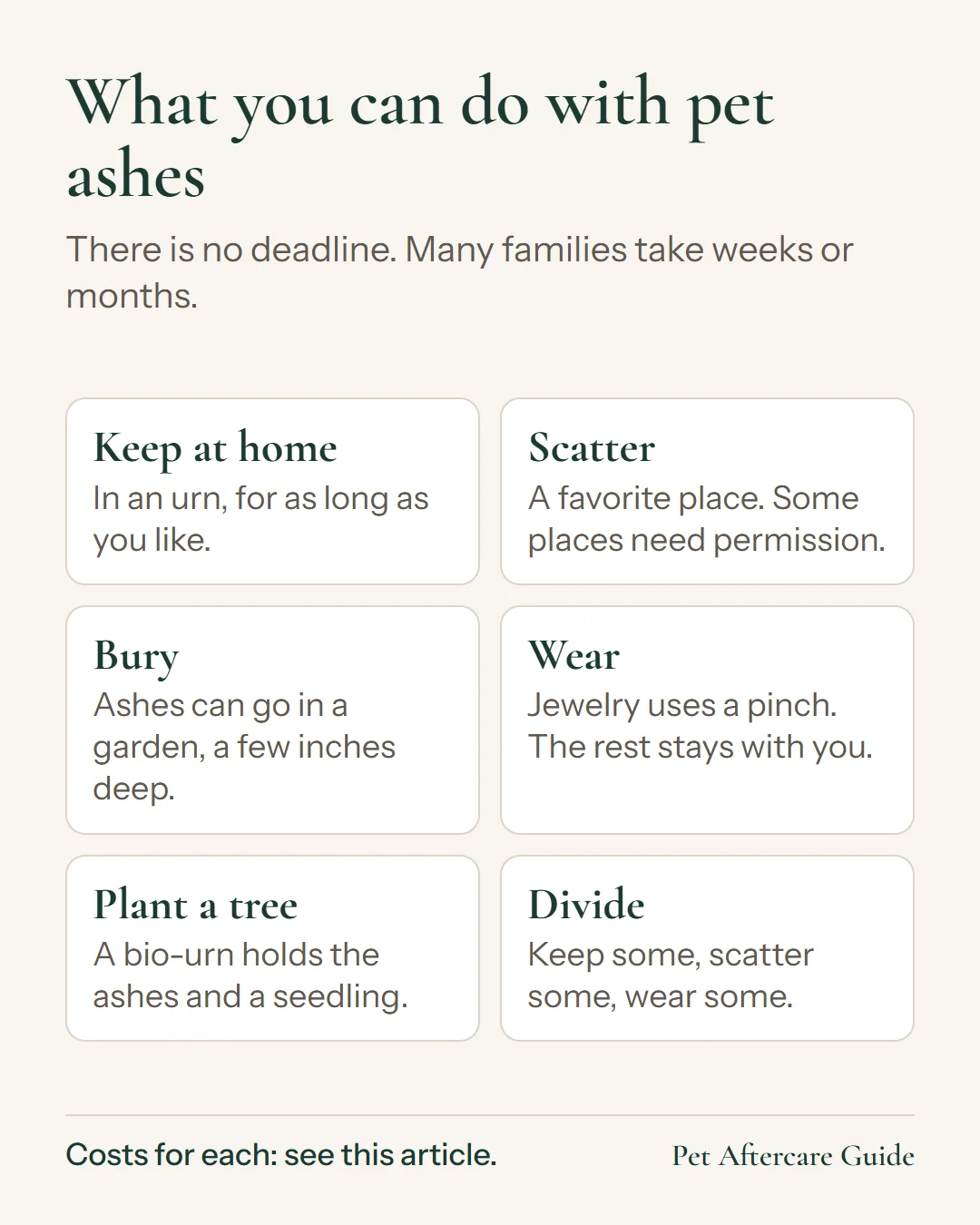
You can keep pet ashes at home in an urn, scatter them outdoors, bury them, use them for memorial jewelry or glass art, or plant a tree above them. You can also divide the ashes and do more than one of these. There is no legal deadline and no wrong choice. Most families take weeks or months before deciding.
If you have your pet's ashes and are not sure what to do with them, you are not behind. There is no timeline. This guide walks through every option, what each involves practically, and how to think about which one fits your situation.
Can you keep pet ashes at home?
Yes, and most families do. There is no law in any US state that prevents you from keeping cremated remains at home. The ashes are inert mineral material, primarily calcium phosphate, and they pose no health or safety concern.
The standard option is a dedicated urn, which can range from a simple wooden box ($30 to $80) to hand-thrown ceramic or custom engraved pieces ($100 to $400+). If you want something that fits on a bookshelf or mantle, there are hundreds of options in materials including wood, ceramic, brass, and resin.
You do not need to transfer ashes to a different container immediately. Most cremation providers return ashes in a sealed plastic bag inside a temporary container. You can leave them there indefinitely while you decide.
A few practical notes for keeping ashes at home: store them away from direct sunlight and humidity (not a bathroom shelf), keep the container sealed if you ever plan to scatter or use them later, and let family members know where they are kept.
What are the options for scattering pet ashes?
Scattering is one of the most common choices for pet ashes. The main options are:
A meaningful outdoor location. A trail your dog loved, a garden, a beach, a lake, a mountain. Most families scatter on private land (their own property or with the landowner's permission) or in natural areas. There are few legal restrictions on scattering pet ashes on private land anywhere in the US. If you are scattering at a beach or lake that is publicly accessible, a low-traffic time like early morning or a weekday is a more considerate choice.
At sea. The 3 nautical mile rule people read about online is the EPA rule for human remains. It does not authorize ocean scattering of pet ashes. Under 40 CFR 229.1, placement of non-human remains, including pets, is not allowed under the MPRSA general permit. Families who want an ocean goodbye must apply for an MPRSA special permit through their EPA regional office. A simpler alternative is to scatter on private land with the owner's permission, which has no federal restriction.
In a national park or public land. The rules vary. Most national parks technically require a permit for scattering, though enforcement is rare. BLM land and national forests generally permit scattering without permits. Always contact the specific park or district if you want clarity before traveling.
Via aerial scattering. Several services will scatter ashes from a small plane; prices vary by company and distance, so ask for a written quote. This can work well for families spread across geographies or for a pet who belonged to the whole family.
Before scattering, check whether the ashes include any metal (from ID tags, microchips, or implants). Most crematories remove these before returning ashes, but it is worth confirming. The ashes themselves are fine to scatter anywhere outdoors.
Can you bury pet ashes at home?
Yes, in most places. Home burial of pet ashes is legal in nearly all US jurisdictions. Unlike burying a whole body, ashes present no sanitation concerns, so the restrictions that apply to whole-pet burial (depth requirements, setbacks from water) generally do not apply to ashes.
If you want to bury ashes in a memorial garden, most families use a biodegradable urn or a simple clay pot at a few inches of depth. A small stone or marker makes the spot identifiable later.
Pet cemeteries also accept ashes for burial, often in a dedicated section or columbarium niche. This can be a good option for families who may move and want the burial site to be permanent and maintained. Prices vary widely and few cemeteries publish them, so ask for the plot or niche fee and the opening fee separately; our pet cemetery guide has published examples.
What is cremation jewelry and how does it work?
Cremation jewelry is any piece that incorporates a small amount of your pet's ashes. The most common types are:
Pendant with a sealed chamber. A small amount of ashes (typically a pinch) is loaded into a sealed glass or metal pendant. These run $50 to $200. The ashes are held inside and are not visible from outside.
Memorial glass. Ashes are mixed into molten glass and shaped into a pendant, bead, or paperweight. The ashes are visible as swirls or texture in the glass. Prices range from $80 to $350. Several independent glassblowers offer this alongside larger companies.
Memorial diamond. A laboratory process extracts the carbon from ashes and grows a synthetic diamond. This takes 7 to 10 months and starts at $3,499 at Eterneva, rising with carat size. Eterneva is the most recognized provider in the US for this service.
Fingerprint or paw print jewelry. Some providers incorporate a pressed image of your pet's paw or your own fingerprint into a silver or gold piece, with or without ashes added.
For any type of cremation jewelry, you typically mail a small amount of ashes (often just 1/4 teaspoon) to the maker. This does not require using all the ashes, so you can still scatter or keep the rest.
Some people also have a small amount of ashes mixed into a memorial tattoo. Our guide to tattoos with pet ashes explains how it works and what to ask the artist.
Can you use pet ashes to grow a tree?
Yes. Bio-urns and living urns are biodegradable containers designed to hold ashes along with a seed or seedling. As the urn breaks down in the soil over time, the tree takes root above it.
The most common product is The Living Urn, which comes with a seedling or seeds of your choice and a planting mix designed to buffer the ashes (which are alkaline and can inhibit germination if not diluted properly). The Living Urn for pets costs $119 for the urn system alone and $149 with a tree voucher.
If you do not want a commercial product, plant an ordinary tree and mix a small portion of the ashes thinly into soil and compost around it, away from the young roots, never in the planting hole. Our guide to planting a memorial tree with your pet's ashes explains how, step by step.
What if I want to wait and decide later?
That is fine. Most families do not know immediately what they want to do, and ashes stored in a sealed container do not degrade. There is no urgency.
The only situation where waiting creates a practical issue is if you plan to move and want to scatter or bury before leaving a home that had meaning for the pet. Beyond that, the decision can wait months or years.
Some families divide ashes: scatter some in a meaningful location, keep some at home in an urn, and use a small portion for jewelry. A single medium dog produces enough ashes (roughly 60 to 80 cubic inches) for all three uses without running short.
If you are struggling to decide, that is also normal. The ashes represent a physical connection to your pet, and there is no wrong answer and no deadline. Take all the time you need. When you are ready, our guide to pet memorial ideas gathers ways to honor your pet, with and without the ashes.
Keep reading
Looking for a way to remember your pet?
Compare urns, jewelry, portraits, garden stones and keepsakes, with real prices and the stores we recommend.
Browse Memorial Products