
How to Plant a Memorial Tree With Your Pet's Ashes
A tree is a memorial that grows, flowers and changes with the seasons, which is why so many families want to plant one with their pet's ashes. This guide explains why ashes can harm a young tree, how a bio urn solves it, how to plant one yourself, which tree to choose and what each option costs.
You can plant a tree with your pet's ashes, but not by pouring them into the planting hole. Ashes have a pH of about 10 to 12 and high sodium, enough to harm a young tree. Use a bio urn with a buffering mix, from $119, or mix a small portion thinly into soil away from the roots.
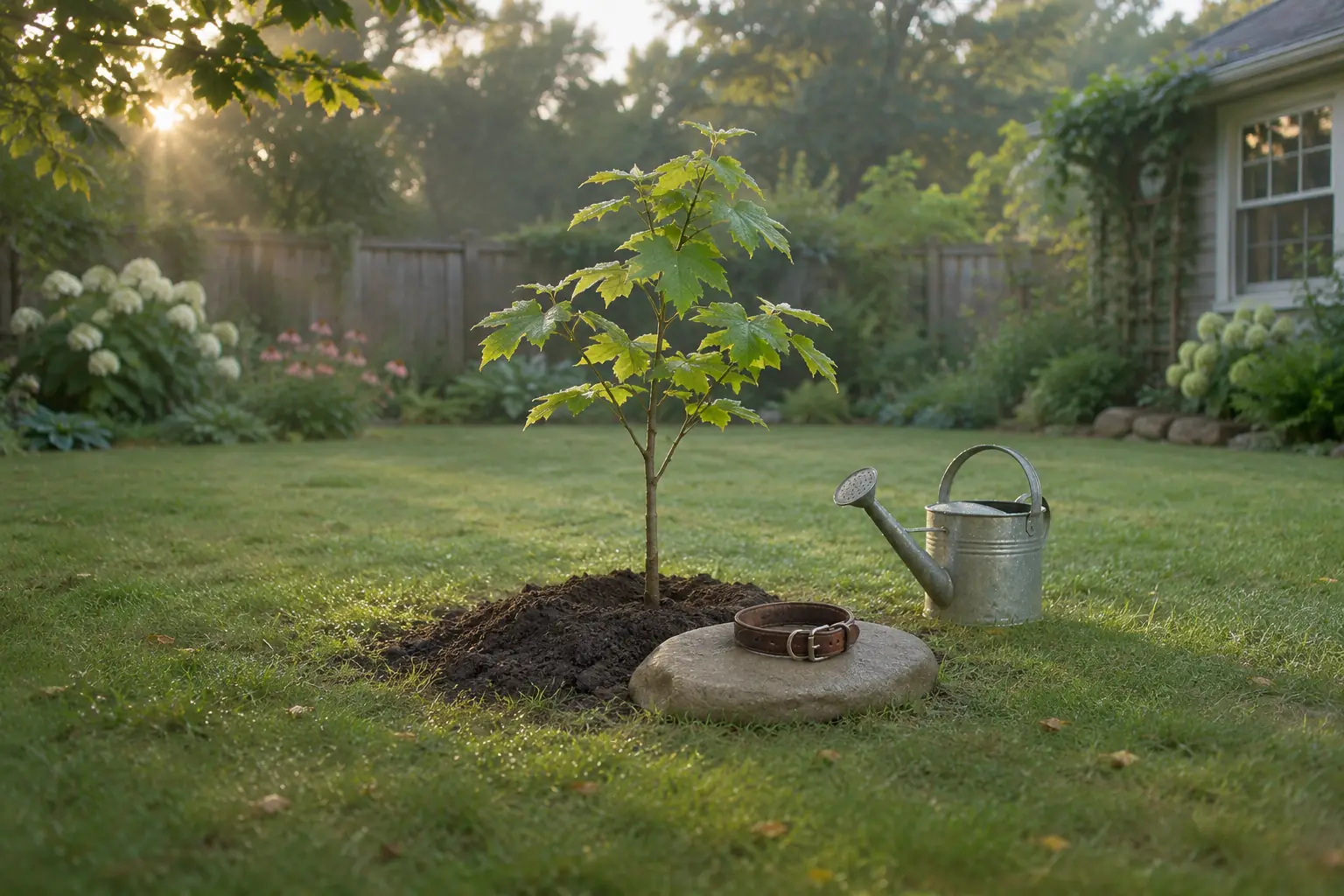
A tree is one of the few memorials that keeps changing: it leafs out in spring, shades the yard in summer and marks the years in rings. Many families want to plant one with their pet's ashes, and it can be done well. The catch is chemistry. Cremated remains are strongly alkaline and salty, and poured straight into a planting hole they can kill the young tree you meant to honor. This guide explains how to avoid that, with or without a special urn, and what each route costs.
Can you plant a tree with your pet's ashes?
Yes. On your own land there is no rule against it, and it is one of the most common things families do with ashes. What matters is how you do it. The ashes should never sit as a solid layer against the roots. Either they go into a bio urn with a buffering mix, or a small portion is spread thinly through a large volume of soil.
It also helps to know how much you are working with. A rough guide is about 1.2 cubic inches of ashes per pound of body weight, so a 10-pound cat leaves roughly 12 cubic inches and a 50-pound dog about 60 cubic inches, close to a liter. Our guide to choosing a pet urn explains the formula. You do not have to use all of it under the tree. Many families keep a small portion at home in a keepsake urn and plant the rest.
Why can ashes harm a young tree?
Ashes are not soft dust or compost. They are crushed bone, made mostly of calcium phosphate, and they come out of the cremation chamber highly alkaline. A laboratory analysis described in a 2021 US patent by an Australian maker of memorial soil products measured cremated remains at a pH of about 10 to 12, while most trees grow best somewhere between 6 and 7.5. The same document reports sodium levels far above what plants tolerate, and notes that salt can stunt or kill trees depending on the species.
The Living Urn, the best-known American maker of tree urns, says the same thing in its product FAQ: cremated remains raise the pH of the surrounding soil and carry elevated sodium, which together create an environment that inhibits plant growth. Both sources sell products that solve this problem, so read them with that in mind, but the basic point is not disputed: ashes are not fertilizer.
What this means in practice:
- Concentration is the danger. A thin dusting mixed through a garden bed rarely causes harm. A full set of ashes packed into one hole can.
- Young roots are the most sensitive. A newly planted sapling is more vulnerable than a tree that has been in the ground for years.
- Your soil matters. If your soil is already alkaline, as it often is in the arid West, it has less room to absorb more.
What does a bio urn like The Living Urn do?
A bio urn is a biodegradable container that holds the ashes together with a mix designed to buffer them, so the tree can grow above it without its roots sitting in raw ash. As the urn breaks down in the soil, the roots reach the treated mix gradually.
The Living Urn is the most established option in the US. On its own site in November 2026, the pet version costs $149 with a voucher for a tree seedling, or $119 for the urn system alone if you would rather buy your own tree at a local nursery. Both include the biodegradable urn, the company's RootProtect ash neutralizing agent, aged wood chips and planting instructions. You can fill the urn when it arrives and store it in the bamboo container it ships in until you are ready to plant.
The urn does not guarantee the tree. The seedling is guaranteed to arrive healthy, but what happens after planting depends on the species, your soil, the weather and watering in the first two summers. Our urns guide covers other biodegradable and traditional urns if you are comparing.
How do you plant a memorial tree without a bio urn?
You can do it yourself with an ordinary nursery tree. The aim is to keep the ashes away from the young roots and spread them thin:
- Choose the tree and the spot first. Plant the tree in a normal hole, at the depth the nursery recommends, with plain soil around the root ball.
- Do not put the ashes in the planting hole. This is the most common mistake, and the one most likely to harm the tree.
- Mix a small portion into plenty of soil and compost. Blend it thoroughly and work it into the top few inches of a wide ring around the tree, a foot or more from the trunk, rather than in one spot.
- Or wait a season. Some families plant the tree first and add the ashes in a ring around it a year later, once the roots are established.
- Water well. Regular deep watering helps carry salts down and away from the root zone.
- Test if you are unsure. A simple soil pH test, or a soil test through your county extension office for a small fee, tells you whether your soil can take it.
If you want to scatter some of the ashes elsewhere too, our guide to where you can scatter pet ashes covers the rules on land and water.
Which tree should you plant?
Pick a tree for the place, not just for the meaning. A species that suits your climate and soil will still be there in 30 years. A favorite that struggles in your yard may not. A few things to weigh:
- Your hardiness zone. The USDA zone map tells you which trees survive your winters. A local nursery will know what thrives near you.
- Mature size. A tree that grows to 40 feet needs at least 15 to 20 feet of clearance from the house, fences and power lines. For a small yard, look at dwarf fruit trees, Japanese maples, dogwoods or a flowering shrub.
- Alkaline tolerance. Since ashes push the pH up, a species that tolerates slightly alkaline soil is a safer choice than one that needs acid soil, such as azaleas or blueberries.
- What it means to you. Some families choose a tree that flowers around the pet's birthday, or one that turns color in the month the pet died.
Evergreens are the quickest route with The Living Urn: the company ships its evergreen seedlings within 3 to 10 days. Seasonal trees such as maples or oaks ship only in planting windows, and seasonal trees cannot ship to Arizona, Alaska or Hawaii because of state plant rules.
When is the best time to plant?
Early spring and fall are the best planting seasons in most of the US, because the tree can grow roots before summer heat or a hard freeze. There is no rush. Ashes keep indefinitely, and many families wait months until the season and their own feelings are right.
The Living Urn's seasonal trees follow that calendar. Ordered from April to mid-November, they ship between November 1 and December 10. Ordered from mid-November through March, they ship between February 26 and May 30. The company asks that you plant within 5 days of arrival.
Where can you plant a memorial tree with ashes?
The simplest place is land you own. Beyond that:
- Someone else's land. A relative's yard or a friend's farm is fine with the owner's permission. Agree on it plainly, since the tree will outlive the conversation.
- Public parks and trails. Planting a tree on public land almost always needs approval from whoever manages it, and many will say no. Some cities run commemorative tree programs where you pay for a tree in a park. Ask whether ashes can be included, as many programs do not allow it.
- A pet cemetery. Some pet cemeteries offer trees or memorial gardens. Our pet cemetery guide explains what they offer and cost.
What if you rent or might move?
A tree in the ground stays with the property. If you rent, or think you may move in the next few years, there are gentler options:
- A large container. A potted tree or shrub, such as a dwarf citrus, a Japanese maple or a rose, can move with you. The Living Urn's Indoors and Patio version for pets costs $159 on its own, or $219 to $339 with a plant included.
- Plant at a family member's home where the tree is likely to stay, with their agreement.
- Keep a portion back. Planting most of the ashes and keeping a small amount in a keepsake means you still have something with you if you leave the tree behind.
A marker helps the spot stay recognizable as the tree grows. Our guide to pet garden stones and markers covers which materials survive outdoors.
How much does a pet memorial tree cost?
| Option | What you pay |
|---|---|
| Your own tree, ashes mixed into soil | The cost of the tree and some compost |
| The Living Urn system, your own tree | $119, plus the tree |
| The Living Urn with tree voucher | $149, seedling and shipping included |
| The Living Urn Indoors and Patio | $159 without a plant, $219 to $339 with one |
Prices from The Living Urn's site, November 2026. Most families spend between nothing beyond the tree and about $150, which is less than many traditional urns.
Can you plant a tree over your pet's grave instead?
Yes, if you buried your pet's body rather than cremating. A shrub or small tree planted near, not directly on top of, the grave is a common way to mark it. Keep the roots and digging clear of the burial, especially in the first year. Home burial itself is regulated locally, and our guide to pet home burial laws covers depth and the rules to check first.
A tree will not replace your pet, and it is not meant to. It gives the grief somewhere to go: a place to sit, something to water and a reason to notice the seasons that your pet would have spent beside you.
Keep reading
Looking for a way to remember your pet?
Compare urns, jewelry, portraits, garden stones and keepsakes, with real prices and the stores we recommend.
Browse Memorial Products