How to Choose a Pet Aftercare Provider: What to Ask and What to Avoid
Choosing who handles your pet's remains is one of the most consequential decisions in an already difficult time. This guide covers what to ask cremation providers, in-home euthanasia providers, and how to evaluate reviews so you can make a confident choice.
When choosing a pet aftercare provider, verify that they are licensed, have a clear process for keeping your pet's remains identified throughout, and provide full pricing upfront. For cremation, ask specifically whether it is private, partitioned, or communal. For euthanasia, verify the vet's license and ask about the intake process. Reviews matter, but always verify the basics yourself.
Choosing who handles your pet's remains is one of the most consequential decisions in an already difficult time. Most families make this choice quickly, under stress, without a framework for evaluating providers. This guide covers what to look for, what questions to ask, and how to evaluate providers for cremation, in-home euthanasia, and burial. It also covers how to read reviews critically and what specific red flags to watch for.
What types of pet aftercare providers exist?
Before evaluating providers, it helps to understand the categories:
Standalone pet crematories: facilities that handle cremation only. Some offer pickup; others require drop-off. They may serve individual pet owners, veterinary clinics, or both. Quality varies widely in this category, and asking the right questions matters more than name recognition. A local-sounding name can also belong to a national group, and our guide to checking who owns a pet crematory shows the two-minute test.
Veterinary clinics with cremation partnerships: many vets do not cremate in-house. They work with a third-party crematory to collect and return remains. The vet is the point of contact, but the crematory does the actual work. Ask which crematory they use and whether you can contact that crematory directly with questions.
Full-service pet aftercare companies: offer multiple services (euthanasia, cremation, burial) under one roof or through coordinated providers. Often the most convenient option; consistency of care across services is a genuine benefit when you want to minimize how many decisions you make under grief.
In-home euthanasia networks: companies like Lap of Love and CodaPet connect pet owners with veterinarians who provide euthanasia at home. The vet may or may not offer cremation services directly; many coordinate with a separate crematory.
Pet cemeteries: see our pet cemetery guide for detailed evaluation criteria specific to burial.
What questions should you ask a cremation provider?
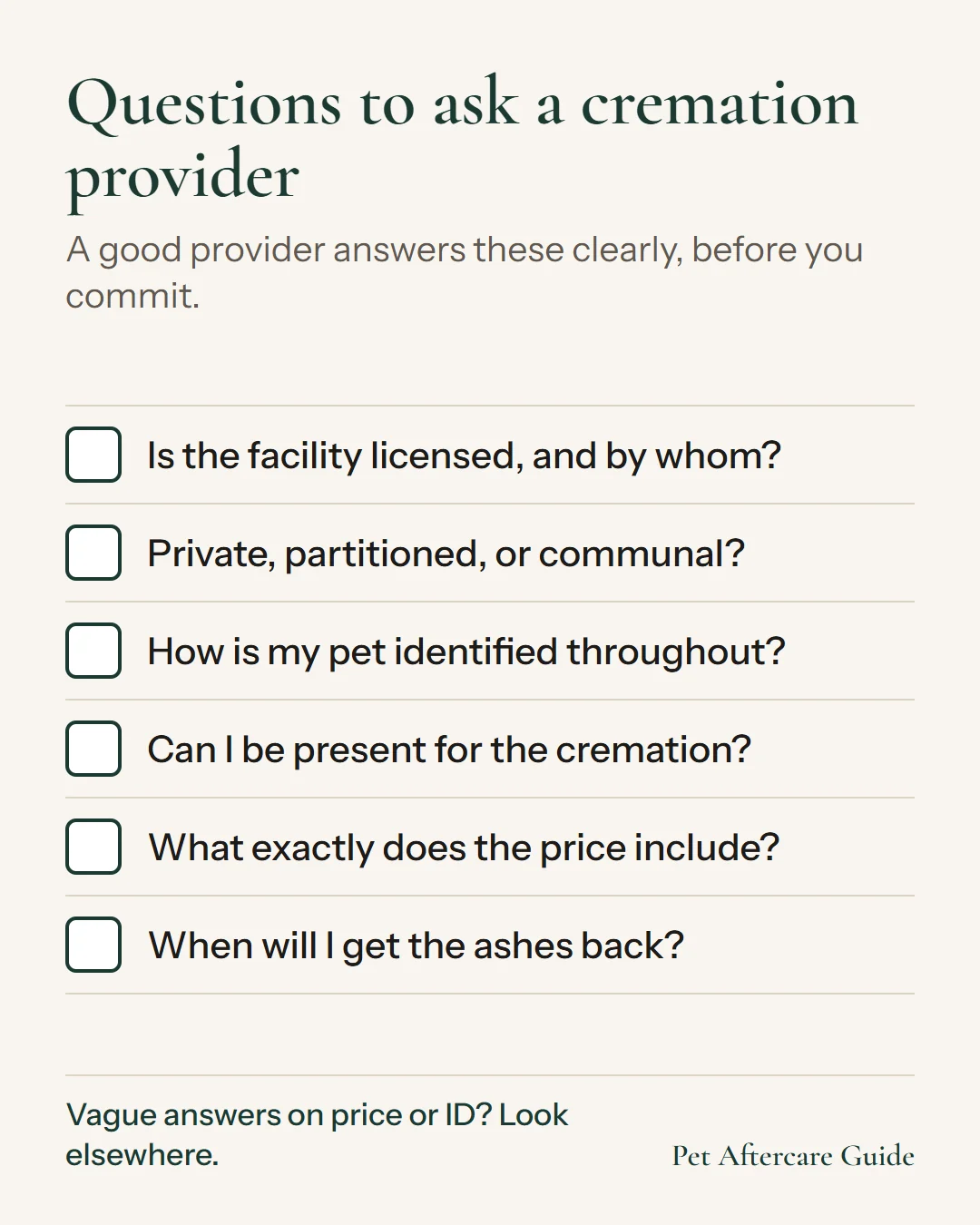
Is the facility licensed? State licensing requirements for pet crematories vary, but most states require some form of registration or permit. Ask what license the facility holds and which state agency oversees them. A straightforward answer builds confidence; evasiveness does not.
What type of cremation do you offer? Private cremation means your pet is cremated alone and the ashes returned are only your pet's. Partitioned cremation means multiple pets are in the chamber at once but physically separated. Communal means multiple pets are cremated together with no separation. Each is a legitimate option at different price points, but you need to know which one you are buying. See our guide on private vs. communal pet cremation for a full explanation.
How is my pet identified throughout the process? A reputable crematory uses a durable ID tag or metal disc that stays with the remains from intake through return. Ask specifically what their identification process is. If the answer is vague or they cannot clearly describe the tracking system, that is a concern worth taking seriously. Our guide to whether the ashes are really your pet's explains how tracking works and what to do if something seems wrong.
Can I witness the cremation? Many crematories offer witness cremation, where the owner can be present when their pet enters the chamber. Not everyone wants this, but knowing whether the option exists is useful. It is also an indicator of a facility's confidence in its own process.
What does the price include? Get a complete itemized breakdown before committing. Ask specifically about: pickup fee, cremation fee, urn or container, return of remains, and any administrative fees. Hidden fees added after the fact are one of the most common complaints in this industry.
How long until I receive the ashes? Typical turnaround is 5-10 days for flame cremation, 10-14 days for aquamation. Rush options are sometimes available at an added cost. Get the current timeline confirmed before booking. Backlogs vary significantly by season and facility size.
What questions should you ask an in-home euthanasia provider?
Is the veterinarian licensed? Ask for the vet's state license number. You can verify most veterinary licenses through your state's veterinary licensing board website in under five minutes. This is a basic check that protects against unlicensed practitioners.
What is the process from booking to appointment? A reputable provider will have a clear intake process: you describe your pet's condition, they confirm whether in-home euthanasia is appropriate, and they schedule an appointment. If a provider will book without any intake conversation, that is a yellow flag worth noting.
What happens if something goes wrong during the appointment? Ask how complications are handled. A good provider will have a clear answer: they carry appropriate medications and know the protocol for situations that do not proceed as expected.
Do you offer aftercare coordination? Many in-home euthanasia providers coordinate cremation or transport after the appointment. Ask whether aftercare is handled in-house, through a partner, or whether you arrange it separately. Knowing this before the appointment removes a decision you will need to make under stress.
Can I see reviews from other families? Look specifically for reviews about the in-home experience: the vet's demeanor, how the appointment was handled, how the remains were treated. Look for consistent patterns across multiple reviews rather than individual extremes.
How do you evaluate reviews for pet aftercare providers?
Reviews for pet aftercare providers require specific judgment:
Look for operational details, not just sentiment. "They were so caring" is less useful than "they called when my pet's ashes were ready and the urn was exactly as described." Specific operational details tell you more about the actual process than general praise.
Weight recent reviews more heavily. Staff and ownership change. A crematory with excellent reviews from several years ago and concerning reviews from the past six months warrants a direct conversation with the provider before proceeding.
Negative reviews about grief, not process, are different. Some negative reviews reflect the reviewer's grief rather than provider failure. Read critically. Look for patterns about operations, communication, and how remains were handled, not just emotional tone.
Ask your veterinarian. Vets see aftercare providers regularly and hear feedback from clients over time. Your vet may have a genuine recommendation or a provider they actively avoid. This is one of the most valuable data points available, more reliable than anonymous online reviews in many cases.
What does a red flag look like?
- Pricing that is vague or unavailable until after you commit
- No clear explanation of how remains are identified throughout the process
- Unwillingness to answer basic questions about licensing
- Multiple recent reviews mentioning mix-ups, long delays without communication, or ashes that were the wrong volume or color
- High-pressure sales of upgrades or add-ons at the time of death
If any of these apply, it is worth looking at alternative providers. The extra time to ask questions before committing is significantly less painful than discovering problems after the fact.
For providers we have already vetted in your area, see our Find a Provider directory and our independent reviews of Lap of Love and CodaPet.
Keep reading
Ready to find a provider near you?
We've reviewed local providers in major cities with verified prices.
Find Providers